
The Corvette is Chevrolet’s two-seat sports car, built continuously since 1953 and now in its eighth generation. It started as a fibreglass roadster with a six-cylinder engine and grew into a mid-engine supercar that still costs far less than most European rivals. Here is what the name means, how it changed, and what owning one in the Gulf looks like.
In this guide
Where the Corvette came from
The first Corvette appeared as a concept at the 1953 General Motors Motorama show in New York. Public reaction was strong enough that Chevrolet put it into production the same year. The early cars were hand-assembled in Flint, Michigan, with fibreglass bodies, all painted Polo White with red interiors, and powered by an inline six called the Blue Flame.
Sales were slow at first. What saved the car was a mix of people: designer Harley Earl, who pushed for an American sports car in the first place, and engineer Zora Arkus-Duntov, who joined GM in 1953 and argued for a V8 and serious performance. The small-block V8 arrived for 1955, and from then on the Corvette became a performance car rather than a styling exercise.
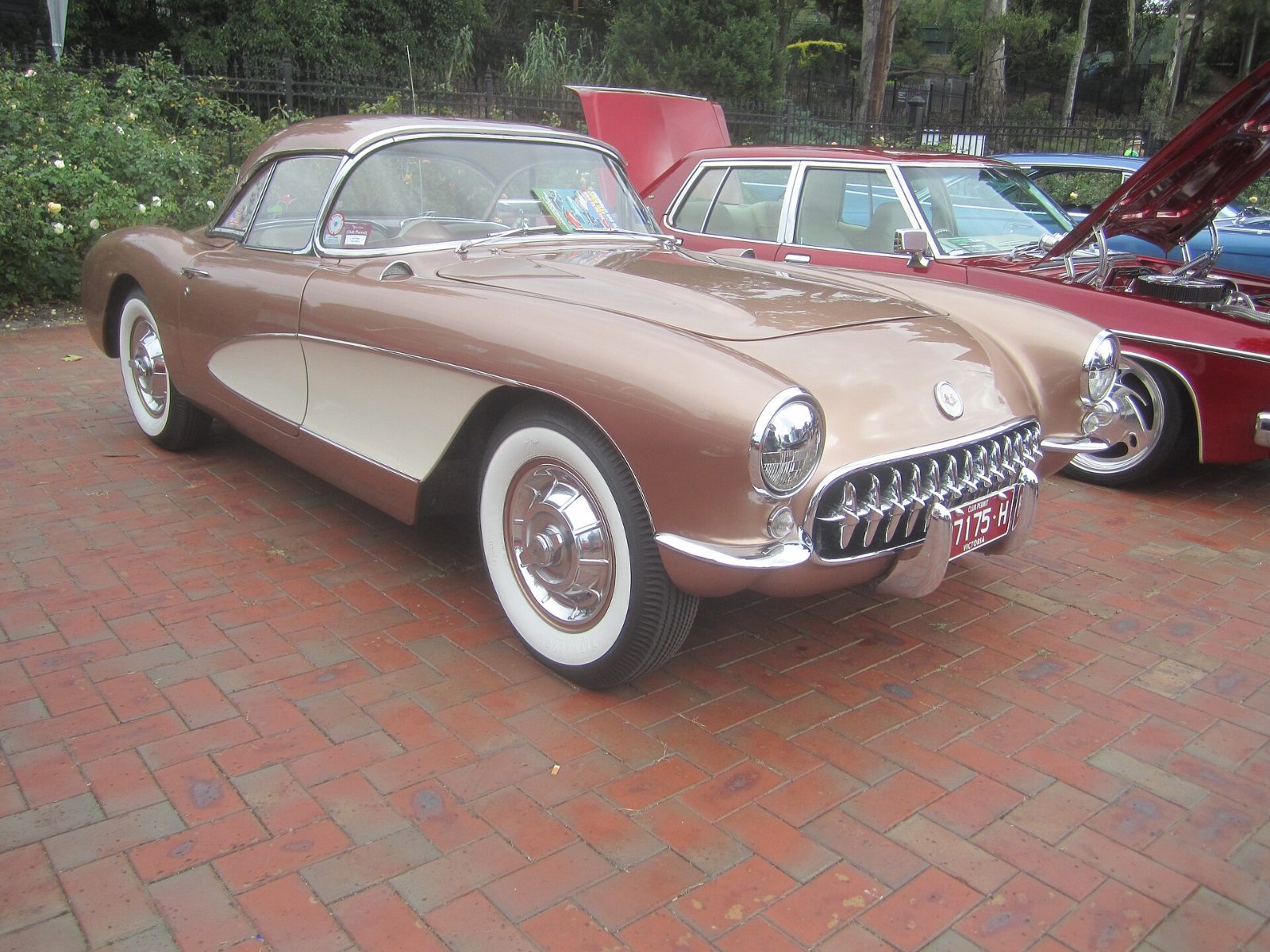
The eight generations at a glance
Enthusiasts refer to each generation by a C-number. Each one brought a new chassis and body, although engines and parts sometimes carried over.
| Generation | Years | Key change |
|---|---|---|
| C1 | 1953 to 1962 | Fibreglass roadster, V8 from 1955 |
| C2 | 1963 to 1967 | Sting Ray name, first coupe, independent rear suspension |
| C3 | 1968 to 1982 | Long-running “Coke bottle” shape, T-tops |
| C4 | 1984 to 1996 | Digital dash, modern chassis, ZR-1 |
| C5 | 1997 to 2004 | Hydroformed frame, LS1 V8, rear transaxle |
| C6 | 2005 to 2013 | Exposed headlights, Z06 and ZR1 |
| C7 | 2014 to 2019 | Stingray name returns, supercharged Z06 and ZR1 |
| C8 | 2020 onward | Mid-engine layout, Z06, E-Ray hybrid, ZR1 |
There was no 1983 model year for customers, which is why C3 ends in 1982 and C4 starts in 1984. For a side-by-side breakdown of dimensions and engines, see our Corvette generations comparison.
Why the Corvette matters
Three things set the Corvette apart from most sports cars.
A long, unbroken name
Few cars have kept one nameplate and one basic idea for more than seventy years. The Corvette has always been a two-seat, rear-wheel-drive (or, with the E-Ray, all-wheel-drive) performance car from one American brand. That continuity is why collectors talk about generations rather than models.
Performance per dirham
Corvettes have traditionally offered big-engine performance at a lower price than European exotics. That has not changed with the C8. The mid-engine Stingray competes on track numbers with cars that cost considerably more, and the Z06 uses a flat-plane-crank V8 that would not look out of place in an Italian supercar.
Racing pedigree
Corvette Racing has competed at Le Mans and in American endurance racing for decades, with multiple class wins. Track work feeds back into road cars, most visibly in aerodynamics, cooling and brakes.
Quick facts
- First shown: 1953 Motorama, New York
- Assembly since 1981: Bowling Green, Kentucky
- Body material: fibreglass and composites for most of its history
- Layout today: mid-engine, rear-drive (Stingray, Z06, ZR1) or hybrid all-wheel drive (E-Ray)
The front-engine to mid-engine switch
For almost seven decades the Corvette had its engine in front of the driver. Arkus-Duntov experimented with mid-engine prototypes as early as the 1960s, but cost and practicality always won. The C8, launched for the 2020 model year, finally moved the V8 behind the seats.
The change improved weight distribution and traction, which matters a lot under hard acceleration. It also changed the car’s character: the C8 only comes with a dual-clutch automatic, so fans of manual gearboxes have to look at C7 and earlier cars.

Owning a Corvette in the UAE
The Corvette is sold through official Chevrolet distributors in the UAE, and a healthy used market exists for C6, C7 and C8 cars. Gulf ownership brings a few specific considerations.
- Heat and cooling. Summer temperatures put cooling systems, batteries and air conditioning under constant load. Keep coolant, AC service and battery checks on a regular schedule.
- Sun on the cabin. Long hours parked outdoors can fade leather and dashboards. Shade, a sunshade and legal window film help.
- Low front ends. Speed bumps and steep car-park ramps are common. Front-lift systems, available on many recent Corvettes, are worth having.
- Tyres. Wide, soft performance tyres age faster in heat. Check the date code and condition, not just tread depth.
- GCC specification. Cars built for the region typically get cooling and climate-control changes. Check whether a used car is GCC-spec or imported.
Budget before you buy
Purchase price is only part of the cost. Insurance, tyres, servicing and registration vary widely by model and driver profile. Our ownership cost calculator lets you plug in your own quotes in AED.
Which Corvette suits which driver
There is no single best Corvette; it depends on how you plan to use it.
- Weekend classic: C1 to C3 cars are about style and driving feel. Expect older technology, more maintenance and the need for a specialist.
- Affordable modern performance: C5 and C6 cars offer a lot of speed for the money and are simpler to work on than newer models.
- Daily-usable sports car: the C7 and C8 have better cabins, more safety technology and stronger air conditioning.
- Track focus: Z06 and ZR1 versions across generations add power, brakes and aerodynamics, at higher running costs.
The right Corvette is the one that matches how you actually drive, not the one with the biggest number on the spec sheet.
Common questions
When was the first Corvette made?
Production began in 1953 after the car was shown at the General Motors Motorama. Around 300 were built that first year.
Is the Corvette a Chevrolet?
Yes. The Corvette has always been sold as a Chevrolet, although recent models carry Corvette badging rather than the Chevrolet bowtie on the body.
Why did the Corvette become mid-engine?
Moving the engine behind the driver improves traction and balance, which helped the C8 match more expensive rivals on acceleration and handling.
Can you buy a new Corvette in the UAE?
Yes, through official Chevrolet distributors. Specifications and prices change by model year, so confirm current details with a dealer.
Sources: Chevrolet Corvette (official), National Corvette Museum, Chevrolet Arabia
Last reviewed: 2026-11-25.